
Why Collaborative Art Projects Matter in Pre-K
Updated: Oct 6

Some of my favorite pieces of artwork hanging around the classroom aren't the ones that every child takes home. They're the giant collaborative projects that we create together.
At first glance, they look like fun bulletin boards full of bright colors and adorable artwork. But if you look a little closer, you'll see so much more. You'll see children making decisions, solving problems, practicing patience, sharing materials, encouraging one another, and taking pride in creating something bigger than themselves, and that's what makes collaborative art so special.
One of the things I love most about teaching pre-k is watching children realize that their contribution matters. Every child brings something different to the table. One child carefully glues cotton balls onto a sheep. Another proudly cuts seaweed for an ocean mural. Someone else adds fingerprints to a jellyfish or stamps tiny insects into a classroom garden. None of those individual pieces would create much on their own, but together they become something beautiful.

Collaborative art also gives children the chance to create without the pressure of making everything "perfect." Since everyone is contributing to one large project, children are often more willing to experiment, take risks, and simply enjoy the process, and that confidence carries over into so many other areas of the classroom.
These projects naturally build so many important skills. Children strengthen their fine motor skills while cutting, gluing, tearing paper, painting, and placing small pieces. They practice communication as they decide where pieces belong and talk about their ideas. They learn cooperation by sharing space and materials. They're developing creativity while also learning that there isn't just one right way to create something.
Some of our favorite collaborative projects have become classroom traditions.
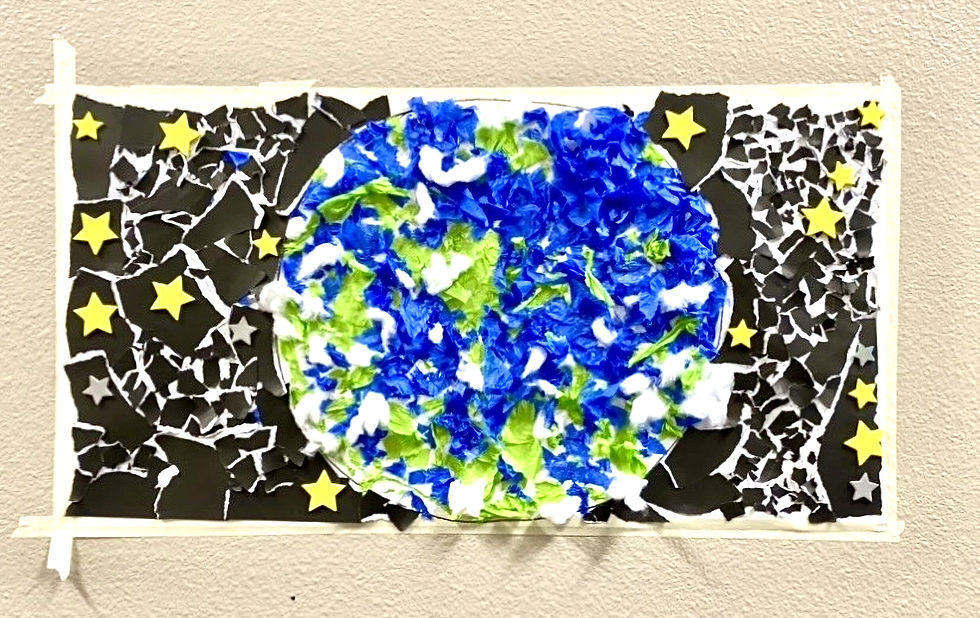
Our giant Earth mural gave every child the opportunity to help "build" the planet one piece of tissue paper at a time before adding fluffy clouds and a star-filled background.
Our insect garden slowly came to life over several days as children added flowers, bugs, grass, sunshine, and all kinds of creative details. By the time it was finished, every inch of the paper told a story.
Our ocean display filled the walls with colorful fish, jellyfish, sea turtles, sharks, octopuses, and starfish. Every child chose a sea creature to create, and together they transformed an empty bulletin board into an underwater world.

Even our simple farm scene became something the children talked about for weeks. One group made fluffy sheep with cotton balls while others created pigs, chickens, trees, fences, and crops. As more pieces were added each day, the children couldn't wait to see how their farm was growing.
One thing I've noticed over the years is that collaborative art becomes more than an art activity. It becomes a classroom memory. Children proudly point out the piece they created when their families visit. They remind one another who made which animal or flower. They revisit the display during play and conversations long after the project is finished.
If you've been thinking about trying more collaborative art in your classroom, my advice is simple. Start with a large piece of paper, choose a theme your students are excited about, gather a variety of open-ended materials, and let the children take the lead. Don't worry about perfection. Some of the best collaborative art projects in pre-k look wonderfully messy because they're filled with genuine child creativity.
In pre-k, we're building far more than bulletin boards. We're building confidence, friendships, communication skills, creativity, and a classroom community where every child knows they have an important place. And honestly, I think that's the most beautiful masterpiece of all.
Happy Teaching! ♥ Brittney


Comments